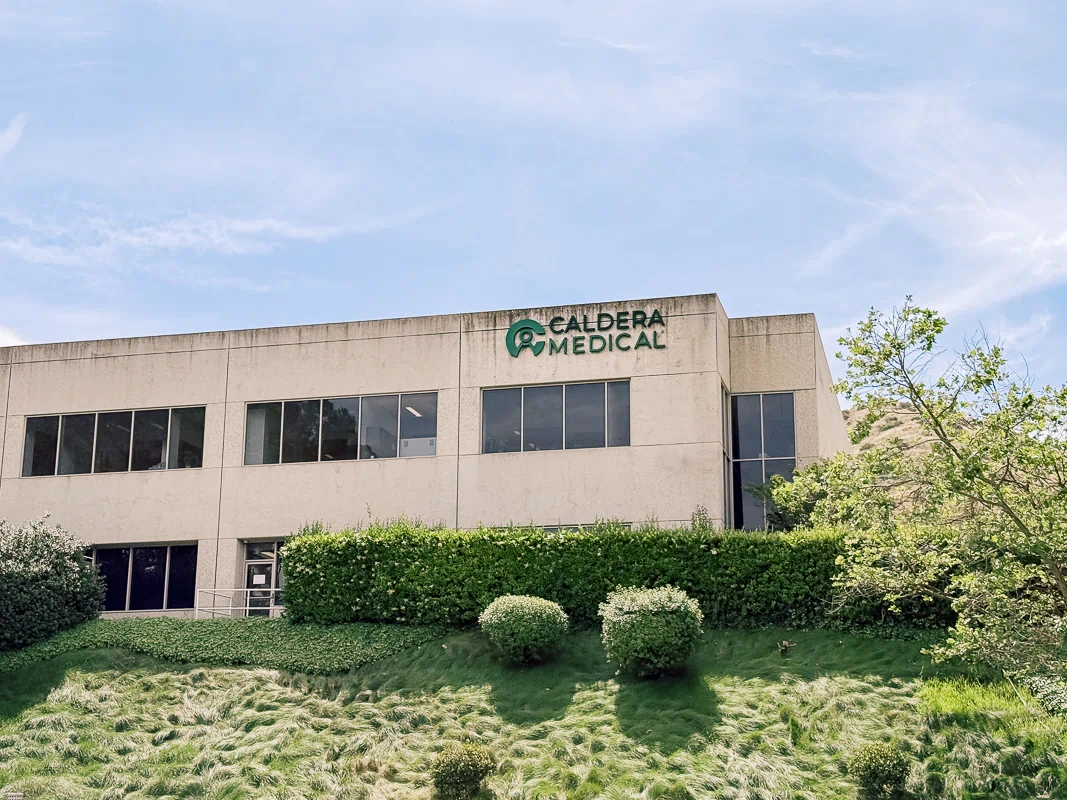
Caldera Medical operates in a clinical and highly specialized healthcare space, where clarity and trust are not optional. Their Westlake Village facility sits on an elevated site, set back from the road, which makes visibility more dependent on scale and placement than proximity.
Description & the Challenge
The challenge here was not simply installing a building sign, but making it readable at distance without overwhelming the architecture. The building sits above street level, partially screened by landscaping and terrain, which reduces direct visibility from passing traffic.
At the same time, the sign had to meet strict code requirements and integrate into an existing façade with limited mounting zones near the parapet. In healthcare, there is also less tolerance for visual noise. The sign needed to feel precise and controlled, not aggressive or overly commercial.
The Solution
We fabricated and installed an illuminated dimensional building sign using halo-lit reverse channel letters, mounted near the upper façade for maximum visibility.
The letters were constructed from aluminum with internal LED illumination, creating a controlled halo effect against the building surface. Electrical components and raceways were routed above the roofline to maintain a clean exterior appearance.
Based on the approved plans, the sign spans a large-scale layout across the parapet zone and incorporates reverse channel construction with low-voltage LED illumination and sealed components for long-term outdoor use.
Design Considerations
Scale was the primary driver. The sign needed to read from a distance across elevation changes, which required careful proportioning of letter height and spacing relative to the façade.
Halo illumination was selected instead of face illumination to reduce glare and create a softer, more controlled presence at night. This approach aligns better with healthcare environments, where visibility matters but visual comfort is equally important.
Material selection focused on durability and consistency. Aluminum construction with sealed lighting components ensures longevity, while the color palette stays within brand guidelines without overreliance on contrast.
Mounting and electrical routing were also critical. By placing wiring above the roofline and keeping penetrations controlled, the installation maintains a clean, uninterrupted façade.
The Impact
The building now reads clearly from the surrounding area, despite elevation and landscaping challenges. The sign establishes the facility as a defined destination rather than a background structure.
During the day, the form and color provide recognition. At night, the halo illumination creates a visible but restrained presence that supports wayfinding without overpowering the building.
Key Benefits
- High-visibility identification from elevated site conditions
- Halo illumination for controlled, low-glare nighttime readability
- Large-scale dimensional lettering aligned with building proportions
- Clean installation with concealed electrical components
- Durable materials suited for long-term exterior exposure
This project is less about adding signage and more about correcting visibility. The result is a system that works across distance, light conditions, and architectural constraints without introducing unnecessary noise.